
What makes Gauteng different?
The dry winter. Gauteng gets its rain in summer, and its winters are dry. That is when soiling does its damage. On the CSIR campus in Pretoria, an uncleaned single-axis tracker plant lost 1.2% of its performance ratio a week through the rain-free winter of 2017, and 1.5–1.8% a week in 2019 (CSIR data in IEA PVPS 2022). After four dry weeks at that pace, a plant is about 5–7% down (our arithmetic).

Birds. At Eskom’s Rosherville PV plant in Johannesburg, one bird dropping on one cell raised its temperature by 11.1 °C and switched on the bypass diode, and dust along a module’s bottom edge made a cell 18.4 °C hotter (Vumbugwa et al. 2020). The energy lost is small; the heat is the problem, because it stresses the cell for as long as the dirt stays. Rows under cables, masts and roosts collect the most droppings. See bird droppings on solar panels.
Mine, road and industrial dust. Johannesburg grew on gold mining, and mine dumps, gravel roads, building sites and industry all add dust. Some of it is more than loose soil. On the Mpumalanga Highveld, solar reflector samples near a ferromanganese smelter in Emalahleni lost 32.6% of their reflectance on average in each 14-day exposure of the 2020 dry season (Swart et al. 2023). Fallout like that can bond to the glass, and then water alone won’t lift it. See desert and mining dust and rust and metal oxides.
Rooftops. Much of Gauteng’s solar sits on commercial and industrial roofs: warehouses, factories, shopping centres and office parks. These arrays are often laid at a low tilt, and soiling falls as tilt rises (IEA PVPS 2022); Trina asks for more frequent cleaning of modules laid flat than of modules at 10° or more. Roofs also make cleaning slower and riskier, which is where drone cleaning helps.
What the published data shows
| Where | Finding | Source |
|---|---|---|
| CSIR campus, Pretoria, dry winter 2017, no cleaning | Performance ratio fell 1.2% a week on a single-axis tracker within 0.5 m of the ground, and 0.4% a week on a dual-axis tracker beside it | CSIR data in IEA PVPS (2022) |
| CSIR campus, Pretoria, dry winter 2019 | 1.5–1.8% a week on single-axis trackers | CSIR data in IEA PVPS (2022) |
| Eskom Rosherville, Johannesburg | One bird dropping on one cell: +11.1 °C, bypass diode on, string down 6 W (0.16%) | Vumbugwa et al. (2020) |
| Eskom Rosherville, Johannesburg | Dust along a module’s bottom edge: +18.4 °C, string down 0.18% | Vumbugwa et al. (2020) |
| Emalahleni, Mpumalanga, near a ferromanganese smelter | Reflector samples lost 32.6% of their reflectance on average per 14-day exposure, 2020 dry season | Swart et al. (2023) |
Three lessons follow. The dry season sets the soiling bill, so plan the cleaning calendar around winter instead of spreading cleans evenly through the year. Geometry matters: at the same site, the low single-axis tracker soiled three times as fast as the dual-axis one. And hot spots from droppings and edge dust matter more than their energy loss suggests. More South African data is in soiling losses in South Africa, and the season’s checks are in the dry-season checklist.
How we work in Gauteng
Our Johannesburg support site is the base for our technicians in the province, with engineering support from our head office in Cape Town.
- Measure first. We find out what is on the glass and what it is costing, with a site soiling assessment and, on larger plants, soiling measurement.
- Test the water. Municipal and borehole water differ, and so do module makers’ hardness limits. We test the water at the nozzle against your maker’s manual. See cleaning-water testing.
- Set up the clean. Method, chemistry, water and equipment, set up and proven for your crews or your O&M contractor. See solar panel cleaning.
- Reach the hard roofs. Drone-applied cleaning for arrays, roofs and façades that crews can’t reach safely. See drone cleaning.
- Prove it on your strings. Utility-scale and large C&I plants qualify for a free pilot: treated strings against control strings, under the same sun.
Soiling or contamination?
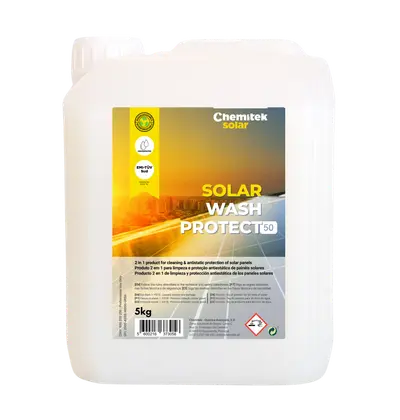
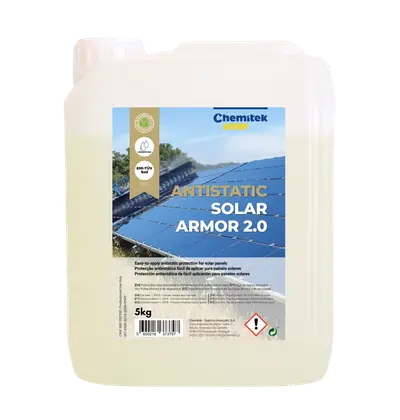
Most Gauteng sites carry ordinary soiling: dust, pollen and droppings that build up between cleans. Solar Wash Protect or Antistatic Solar Armor 2.0 in the normal clean handles it. Chemitek’s field cases show what that gains over water alone, from a commercial rooftop in India, under greasy factory fumes and fine dust, to a utility plant in Honduras.
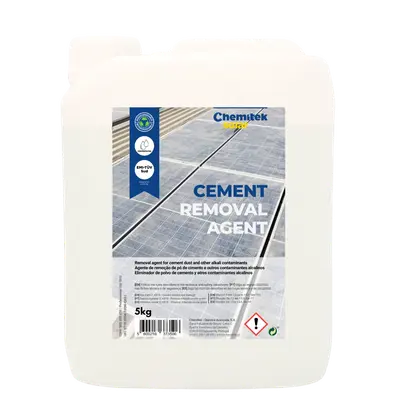
Sites beside smelters, quarries, cement works or busy roads can carry contamination instead: a film that bonds to the glass and keeps building until it is removed. Scraping it off scratches the anti-reflective coating and can void the module warranty. It needs a remover first, then a coating, as in our Restore → Protect → Maintain programme. On a rooftop plant in Türkiye where metal dust had cured onto the glass, one clean with Chemitek Metal Oxides Removal Agent cut the shortfall against expected output from 12.64% to 3.76% (six-month averages).
Beyond Gauteng
Where else we work. Our head office is in Cape Town, our second support site is in Upington for the Northern Cape, and we have a presence in North West, the Free State, the Eastern Cape, Limpopo and Mpumalanga. We also work on solar, wind and CSP plants in Namibia, Botswana, Zimbabwe and Mozambique, and supply Chemitek products throughout the region. For the cement and limestone belt, see the North West guide; for the arid west and CSP, the Northern Cape guide. Wherever your plant is, the first step is the same: find out what is on the glass and what it costs.
Chemitek products for this
- Clean + protectSolar Wash ProtectConcentrated PV cleaner that leaves an antistatic, anti-adherent layer. 18 module-maker letters of conformity.
- ProtectAntistatic Solar Armor 2.0Anti-soiling coatings dosed into the wash water at 1 kg to 1,000 L. At least 12 months of protection (Chemitek).
- RestoreCement Removal AgentDissolves cured cement dust, stone dust and gypsum that water can’t shift. 8 module-maker letters of conformity.
Running your own crews? You can order just these products from us, with or without our engineers.


